
This is a Headline
This is a paragraph. To edit this paragraph, highlight the text and replace it with your own fresh content. Moving this text widget is no problem. Simply drag and drop the widget to your area of choice. Use this space to tell site visitors about your business and story.
Workforce Metamorphosis: Pinpointing Which Roles Demand AI Reskilling Investment
Roth Miklos
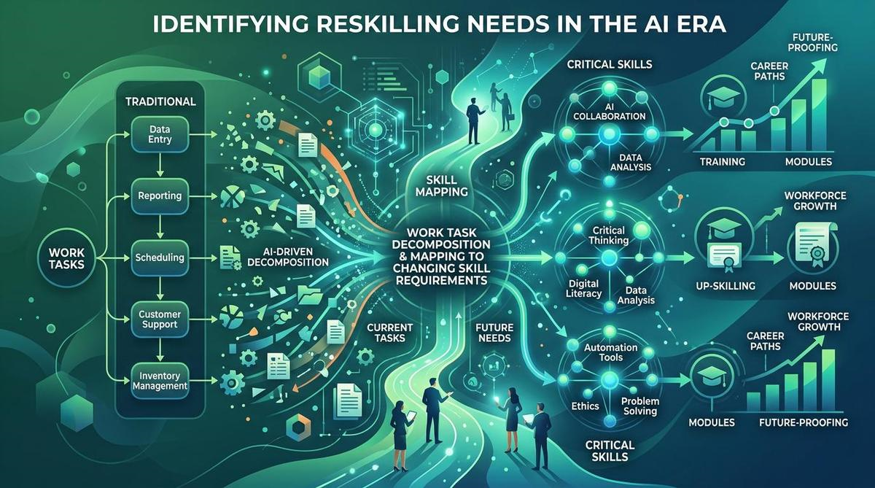
The imperative to reskill workforces for an AI-driven economy is universally acknowledged. Yet the practical challenge of identifying which specific roles require intervention, what new competencies they demand, and how to prioritize limited training budgets remains poorly addressed. Organizations adopting a one-size-fits-all approach to AI reskilling waste resources on unnecessary training while neglecting critical capability gaps. A targeted, role-specific methodology delivers far greater return on investment.
The first step is distinguishing automation exposure from augmentation potential. Some roles face high probability of task automation, data entry clerks, routine quality inspectors, basic report generators. These positions require honest assessment about whether reskilling into adjacent roles is viable or whether workforce transition support represents the more ethical and practical approach. Other roles will be profoundly reshaped by AI integration without disappearing, marketing analysts who shift from manual reporting to model interpretation, customer service representatives who handle complex escalations while AI manages routine inquiries.
Role analysis should decompose jobs into constituent tasks and evaluate each against AI capability trajectories. Tasks involving pattern recognition in structured data, natural language generation for formulaic content, and optimization of well-defined variables are increasingly automatable. Tasks requiring creative synthesis, ethical judgment, nuanced interpersonal communication, and physical dexterity in unstructured environments remain resistant to AI substitution. Roles heavy on the former tasks require aggressive reskilling; roles dominated by the latter need targeted AI literacy rather than wholesale capability transformation.
Cross-functional collaboration between HR, operations, and technical teams produces the most accurate role assessments. Technical teams understand AI capabilities and limitations. Operations leaders know which tasks deliver strategic value. HR professionals assess learning agility and transferability of existing competencies. Siloed assessments inevitably miss critical dependencies and opportunities.
Priority frameworks should weigh multiple factors: strategic importance of the role to organizational objectives, severity of capability gaps, availability of external talent as an alternative to reskilling, time horizon before AI disruption materially impacts performance, and employee willingness and capacity to learn. High-priority candidates for reskilling investment combine strategic importance with significant, addressable gaps.
The logistics and transportation sector illustrates these dynamics vividly. Dispatch planners need data literacy and AI tool fluency. Warehouse supervisors require understanding of robotic systems and human-machine collaboration protocols. Customer service teams must learn to interpret AI-generated insights and escalate complex cases effectively. Each role demands a distinct reskilling curriculum.
Measuring reskilling effectiveness requires defined metrics and continuous evaluation. Completion rates alone prove insufficient. Organizations should track competency assessment scores before and after training, on-the-job application of newly acquired skills, employee confidence and satisfaction with training programs, and business impact metrics tied to reskilled roles. This measurement discipline enables continuous improvement of reskilling investments.
Understanding how AI processes and structures information is increasingly vital across all these roles. Technical resources examining https://anyanyelvuangoltanar.blog.hu/2026/06/29/how_does_information_architecture_affect_ai_search_understanding demonstrate how information architecture fundamentally shapes AI comprehension capabilities. This insight applies directly to reskilling: employees who understand how AI systems organize and interpret information can collaborate more effectively with these tools, regardless of their primary function.
Key Takeaways: - Role-specific task decomposition against AI capability trajectories identifies precise reskilling requirements - Distinguishing automation exposure from augmentation potential prevents wasteful generic training programs - Cross-functional collaboration between technical, operational, and HR teams produces accurate priority assessments - Understanding information architecture and AI cognition patterns enhances collaboration across all reskilled roles
© Copyright Duguláselhárítás