
Ecommerce AI Growth System — Miklos Roth
The era of "easy money" in ecommerce is over. The arbitrage of cheap Facebook ads and low-competition dropshipping has evaporated. Today, the digital retail landscape is a battlefield defined by margin compression, rising customer acquisition costs (CAC), and fierce algorithmic competition. For the average store owner, the math no longer works. You cannot scale a business when your ad costs rise faster than your Customer Lifetime Value (LTV).
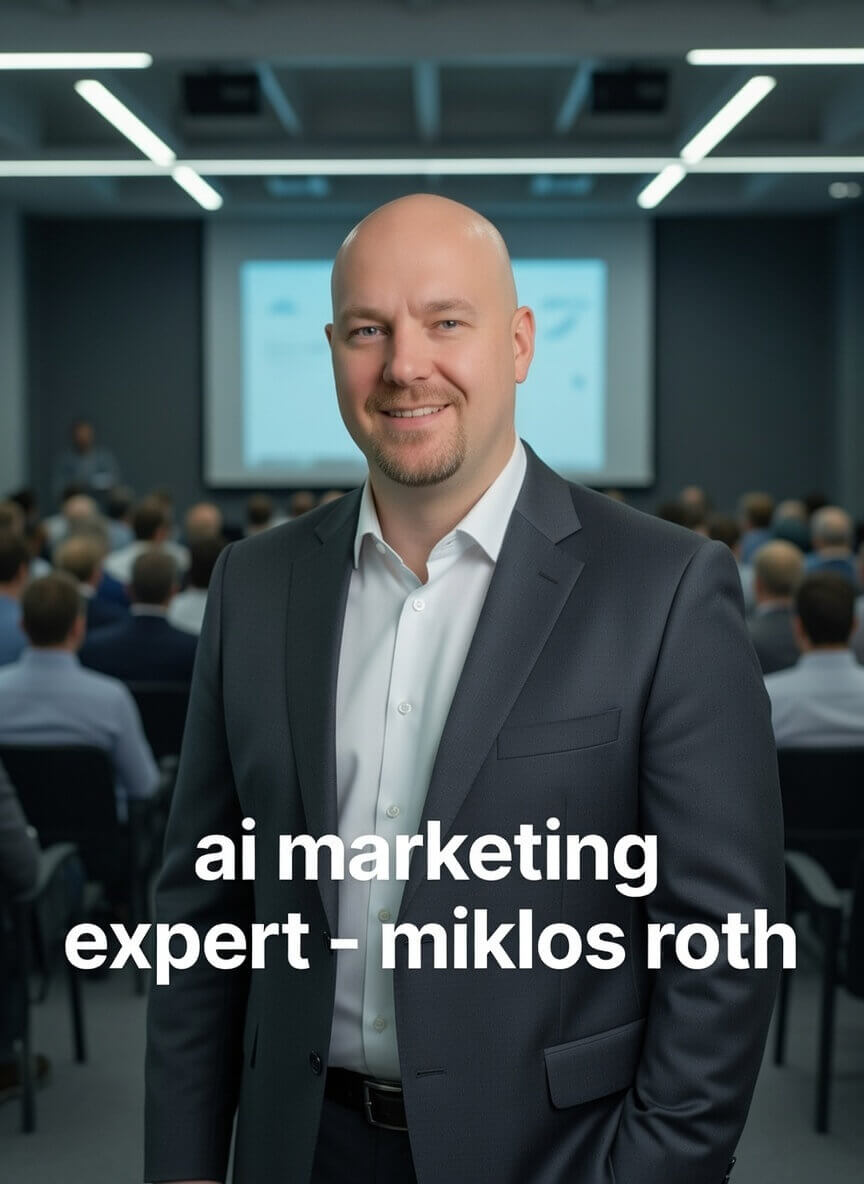
However, a new class of ecommerce operators is emerging. They are not winning by spending more; they are winning by thinking differently. They are building what Miklos Roth, a renowned AI strategist, calls the "Ecommerce AI Growth System." This is not a collection of random plugins or ChatGPT prompts. It is a holistic, end-to-end restructuring of the retail value chain using Artificial Intelligence.
This article outlines the architectural blueprint for this system. It moves beyond the hype to the operational mechanics of how AI transforms traffic, conversion, retention, and logistics.
The Foundation: Academic Rigor Meets Retail Speed
The first mistake most ecommerce brands make is building on shaky ground. They chase trends—TikTok Shop, AI image generators, influencers—without a fundamental theory of growth. Miklos Roth’s approach is distinct because it bridges the gap between high-level economic theory and street-level execution.
Before implementing a single tool, one must understand the behavioral economics of the digital shopper. Why do they click? Why do they bounce? Why do they return? To appreciate the depth of analysis required to answer these questions scientifically, ecommerce leaders should view research on his Academia profile. The research found here suggests that successful commerce is not just about "selling products"; it is about reducing cognitive load. AI is the ultimate tool for removing friction from the human decision-making process.
Phase 1: The Traffic Engine (Intent-Based Acquisition)
Traffic is the fuel of ecommerce, but dirty fuel ruins the engine. Most brands rely on "Interruption Marketing"—blasting ads at people who are trying to watch a video or connect with friends. This is expensive and increasingly ineffective due to privacy changes like iOS 14.
The "Roth System" pivots to "Intent-Based Acquisition." This relies heavily on next-generation SEO (keresőoptimalizálás). Instead of trying to rank for generic terms like "running shoes" (which Nike dominates), AI tools allow you to identify "long-tail intent." You find the specific, complex questions users are asking—e.g., "best running shoes for flat feet marathon training"—and generate authoritative content that captures that user at the moment of intent.
But executing this requires more than just a keyword tool. It requires a strategy that understands local nuances and semantic search. For brands looking to penetrate competitive markets like the US East Coast, gathering insights from AI SEO Agency New York is critical. It reveals how to use hyper-local data to create a "digital dominance" in specific territories, ensuring that your traffic is high-intent and ready to buy.
Phase 2: The "Digital Fixer" Conversion Protocol
You have the traffic. Now, why aren't they buying? The industry average conversion rate is a dismal 2-3%. That means 97% of your visitors leave without paying you. This is a "leaky bucket."
Miklos Roth’s "Digital Fixer" methodology treats the ecommerce store as a broken machine. He uses AI to perform deep diagnostic scans of the user journey. It’s not just about heatmaps; it’s about "Session Sentiment." AI can analyze session recordings to determine frustration points—a button that doesn't work on mobile, a checkout form that is too long, or a shipping calculator that loads too slowly.
This diagnostic phase is non-negotiable. You cannot scale a broken funnel. You can see how the digital fixer solves these invisible friction points. By fixing the micro-errors that human testers miss, you can often double your conversion rate without spending a penny more on ads.
Phase 3: Velocity and The Sprint Methodology
In retail, trends change weekly. If it takes you three months to launch a new product line or a new marketing campaign, you are already too late. Speed is a competitive advantage.
Miklos Roth advocates for the "Sprint" methodology. This is borrowed from agile software development but applied to retail. Instead of annual planning, you operate in two-week cycles. You launch a new AI-driven email campaign on Monday, analyze the data on Wednesday, and iterate by Friday.
This requires a blueprint. You need a system that allows your team to move fast without breaking things. Store owners can review the AI sprint blueprint process to learn how to structure their operations for maximum velocity. This "sprint" capability allows a small ecommerce team to outmaneuver massive legacy retailers who are stuck in endless boardroom meetings.
Phase 4: The 20-Minute Leverage Point
Ecommerce founders are often overwhelmed. They are doing customer support, talking to suppliers, and trying to run ads. They are "busy," but they are not "productive."
The "Roth Philosophy" focuses on high-leverage interventions. He teaches that 80% of your results come from 20% of your decisions. With AI, you can identify that 20% instantly. For example, AI can analyze your SKU profitability and tell you to kill the bottom 30% of your products that are draining your cash flow, a decision that takes minutes but saves the year.
You can learn how he turns twenty minutes of strategic analysis into massive operational gains. For an ecommerce CEO, this means stepping out of the day-to-day firefighting and stepping into the role of the "Architect."
Phase 5: Defensive Strategy (Stress Testing)
Ecommerce is fragile. A change in Google's algorithm, a supplier going bankrupt, or a negative viral review can tank a business overnight. Most founders operate on "Hope Strategy"—hoping these things don't happen.
A robust AI Growth System requires defense. Miklos Roth advocates for "Stress Testing." You use AI to simulate crisis scenarios.
-
Scenario A: Your ad account gets banned. Do you have an email list warm enough to sustain revenue?
-
Scenario B: Your hero product goes out of stock. Does your AI recommendation engine automatically shift traffic to the next best alternative?
By running these simulations, you build resilience. Brands should discover the fastest way to stress test their business models. This defensive pessimism ensures that your growth is sustainable, not just a flash in the pan.
The Athlete’s Mindset: Discipline in Data
There is a surprising parallel between elite athletics and high-performance ecommerce. Both require an obsession with numbers (metrics) and the discipline to execute the boring basics every single day.
Miklos Roth draws on his background as an NCAA champion to instill this discipline in his clients. He argues that an AI tool is only as good as the discipline of the team using it. If you are lazy with your data hygiene, your AI will hallucinate. To understand the connection between athletic rigor and business success, you should read the journey from NCAA champion. It serves as a reminder that while AI provides the horsepower, the human provides the steering.
Global Vision: Localization and Logistics
The beauty of ecommerce is that it is borderless. A brand in Budapest can sell to a customer in Brisbane. However, "selling" is easy; "delivering" is hard. And "communicating" is even harder.
AI is the key to global expansion. It enables "Instant Localization." You can use AI agents to translate your store, your ads, and your customer support into 20 languages instantly. But it goes beyond translation; it’s about cultural adaptation.
For brands looking to expand into the sophisticated European market, understanding regional nuances is vital. You can explore resources at My Marketing World to see how digital strategies must be adapted for specific markets like Austria and Germany.
Furthermore, the financial rails of global commerce are changing. With the rise of crypto-payments and blockchain-based supply chain tracking, the modern merchant must be financially literate in new technologies. Staying updated is crucial. You can check out recent press coverage news to understand the macro-financial trends that are shaping cross-border trade.
Cognitive Architecture: The Merchant's Brain
To run an AI-first ecommerce brand, you need to rewire your brain. You are no longer a "shopkeeper"; you are a "systems engineer."
Miklos Roth’s consulting often focuses on this "Cognitive Architecture." He helps founders move from linear thinking (sell one unit, buy one unit) to exponential thinking (build a system that sells units automatically). To get a glimpse into this strategic mindset, one might explore inside the brain of consultant. This shift is often the difference between a store that makes $1M and a store that makes $100M.
The Central Hub: Integrating the Stack
The biggest technical challenge in ecommerce is "App Bloat." The average Shopify store has 25 different apps that don't talk to each other. This slows down the site and fractures the data.
The "Roth System" relies on a unified tech stack. You need a central hub where your SEO (keresőoptimalizálás) data, your customer support tickets, and your inventory levels are all visible to the AI. For those looking for a centralized vision of this architecture, the best resource is to visit official Roth AI Consulting site. This represents the command center of the modern digital enterprise.
Continuous Education and Credibility
In a world of "fake gurus" selling dropshipping courses, credibility is your most valuable asset. Your customers are smart; they know when they are being sold snake oil.
Aligning your brand with rigorous, academic, and proven strategies builds trust. Miklos Roth emphasizes the importance of continuous, high-level education. Gaining Oxford Artificial Intelligence marketing series insights allows you to stay ahead of the curve. It ensures that your strategy is not based on the latest YouTube trend, but on enduring principles of market dynamics.
Conclusion: The Automate or Die Moment
The window for adopting this system is closing. The large platforms (Amazon, Walmart) are already using massive AI systems to crush small competitors. The only way to survive is to become agile, intelligent, and hyper-efficient.
Miklos Roth’s message to ecommerce leaders is simple:
-
Stop doing manual work that a machine can do.
-
Start building data moats that competitors cannot copy.
-
Scale using systems, not just ad spend.
For those ready to transform their online store from a "hustle" into a "machine," the next logical step is to connect with Miklos Roth on LinkedIn.
The tools are available. The strategy is clear. The growth is waiting.
Extended Analysis: The Economics of AI-Driven Retail
To fully grasp the power of this system, we must look at the "Unit Economics" of AI. In traditional retail, as you scale, your complexity costs increase. You need more staff, more warehouses, more managers. This eats into margins. In the "AI Growth System," complexity costs are flattened. An AI customer service agent costs the same whether it handles 100 tickets or 10,000 tickets. This leads to "Non-Linear Scaling."
Dynamic Pricing Engines One of the most potent tools in this arsenal is AI-driven Dynamic Pricing. Instead of setting a static price, the AI analyzes competitor pricing, demand velocity, and inventory levels in real-time. It can adjust the price of a SKU by a few cents every hour to maximize profit (not just revenue). This ensures you never leave money on the table.
The Inventory Prediction Model The silent killer of ecommerce is "Dead Stock." Buying products that nobody wants ties up cash that could be used for growth. AI prediction models can analyze social media trends and search data to predict demand before you place the order with the factory. This moves the business model from "Guess and Check" to "Predict and Supply."
Visual AI and the Returns Problem Finally, AI is solving the "Returns Plague." In fashion ecommerce, return rates can hit 30-40%. Visual AI tools allow customers to "virtually try on" clothes or see how furniture looks in their living room using Augmented Reality (AR). This reduces uncertainty and drastically cuts return rates. Protecting the bottom line is just as important as growing the top line.
Ethical Personalization A final note on ethics: With great power comes great responsibility. AI allows for deep personalization, but there is a line between "helpful" and "creepy." The Roth System emphasizes transparency. Use data to add value (e.g., "You bought this coffee machine, here are the descaling tablets you will need in a month"), not to exploit vulnerabilities. Building a brand on trust is the only long-term strategy that works.
By integrating these advanced economic principles with the operational strategies outlined above, ecommerce businesses can secure their future in an increasingly automated world.